Creating Virtual Machines in DaDesktop via Virt Manager
Introduction
When developing course materials, virtualizing a server within DaDesktop is often beneficial. Additionally, it is common to virtualize one or two client machines, either using the same OS or a combination of Windows and Linux.
Implementing 'Nested VMs' can be achieved through Virt Manager or VirtualBox. When using Linux, Vagrant is also an optional choice, whereas VirtualBox is the alternative for DaDesktop machines running Windows 10.
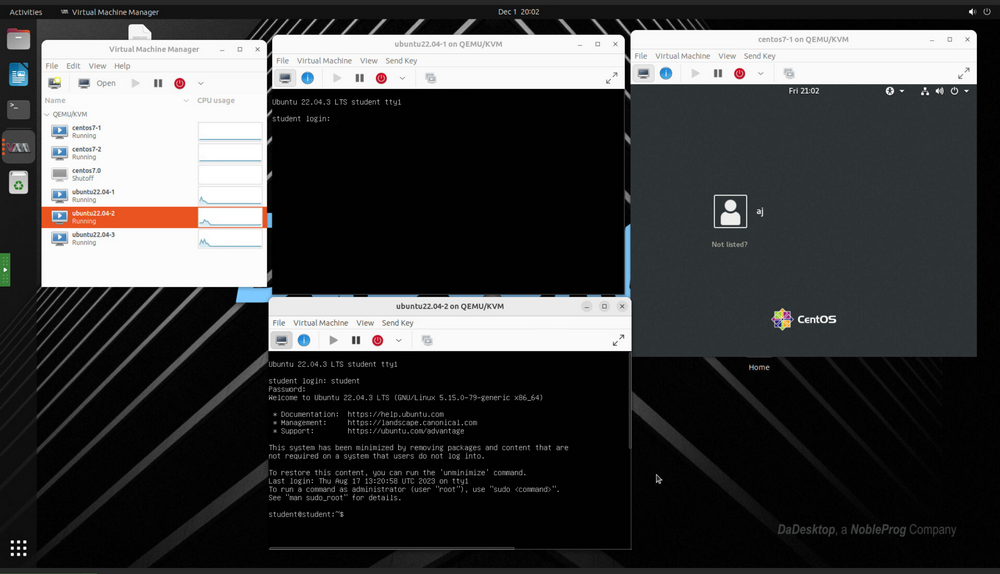
Based on thorough testing, we recommend Virt Manager, as VirtualBox presents certain bugs in this context. Consequently, we currently do not advise using VirtualBox for this specific setup.
The VirtManager application leverages the libvirt library to deliver virtual machine management services. Its desktop interface simplifies the creation, deletion, and management of multiple virtual machines. While primarily designed for KVM VMs, it also supports other hypervisors, including Xen and LXC.
Virt Manager also integrates seamlessly with Vagrant, simply :-
apt install vagrant-libvirt
Please note that fewer Vagrant boxes are directly available for libvirt/kvm compared to VirtualBox. However, these can be easily adapted to work with libvirt, as demonstrated here :-
https://medium.com/@gamunu/use-vagrant-with-libvirt-unsupported-boxes-12e719d71e8e
The user interface offers a comprehensive overview of all VMs, including their status, CPU usage, real-time performance graphs for active VMs, and resource utilization statistics.
If you are new to Virt Manager, note that it resembles VirtualBox but includes several key differences detailed below.
For a solid guide on using virt-manager with Ubuntu Linux, refer to - https://www.debugpoint.com/virt-manager/
Why should I use Virt Manager instead of Virtualbox?
Advantages
- Superior performance - Virt Manager utilizes VirtIO drivers for storage, networking, and graphics, yielding significantly better results. Virtio drivers are paravirtualized device drivers for KVM, available for Linux and Windows guest VMs on KVM hosts. The virtio package supports block (storage) devices, network interface controllers, and graphics. As open-source drivers, they are easily installable if not pre-installed in your Linux distribution.
- Greater configurability options
- Strong compatibility with Vagrant
- Some components of VirtualBox are not fully open source
- Virt Manager avoids the need for module recompilation after kernel upgrades, a common issue with VirtualBox.
- VirtualBox is occasionally prone to breaking following kernel updates.
Disadvantages
- VirtualBox may offer a slightly gentler learning curve
- Configuring 'Host networking' rather than NAT is simpler in VirtualBox, though NAT handles most networking cases effectively in both systems.
- VirtualBox is available on numerous platforms, whereas Virt Manager is exclusive to Linux
Overall, for running servers within a DaDesktop machine, Virt Manager is the preferred choice.
Installation
Since libvirt is continuously evolving, it is best to use the latest non-LTS Ubuntu or Debian version.
To install kvm and virt-manager, refer to the following brief installation notes. However, consult an up-to-date guide for your specific DaDesktop OS. One such guide is https://www.debugpoint.com/virt-manager/
sudo apt install virt-manager
sudo adduser student libvirt
sudo systemctl restart libvirtd
Restart the DaDesktop machine, then launch Virt Manager from the Applications menu.
Configuration
- How do I import or convert virtual machines ? While creating VMs tailored to your OS and specification requirements is straightforward, complex setups often benefit from importing existing VM configurations for specific servers or appliances. These are frequently provided as VMDK images. Although it is unclear if direct addition to Virt Manager is currently possible, VirtualBox server images cannot be imported directly. Instead, they should be exported to other virtualization formats like Open Virtualisation Format (.OVF), which Virt Manager imports easily. Alternatively, you can use VMware Converter or Virt-V2V https://www.redhat.com/en/blog/importing-vms-kvm-virt-v2v. Qemu-convert is also an excellent open-source tool for converting between different virtual machine formats.
To convert from VirtualBox to Virt Manager KVM format , follow these instructions: https://ostechnix.com/how-to-migrate-virtualbox-vms-into-kvm-vms-in-linux/ -
Best method for importing large files into standalone environments. A feature has recently been added to easily upload files from your host machine to your DaDesktop environment.
Alternatively, consider using cloud file services such as Google Drive or Microsoft 365. These can be accessed by logging into the service within the DaDesktop machine.
- When importing virtual machines, particularly from other formats, you will often need to adjust graphics and/or disk types. A major advantage of Virt Manager is its excellent support for VirtIO drivers. These open-source, fully virtualized drivers offer superior performance compared to standard disk, network, or graphic drivers and are available for nearly all operating systems, including robust support for Windows 10 guest machines. If your Guest OS supports them, these are generally the preferred option for compatibility and performance when using Virt Manager (KVM). https://wiki.archlinux.org/title/Libvirt
- Optimal settings for virtual machines using Virt Manager VirtIO drivers are included in almost all modern open-source server operating systems and can be easily installed in Windows. Generally, virtio drivers are the best choice, though other types may be necessary in specific cases. NAT is sufficient for most networking scenarios unless a more complex setup requiring Bridged Host networking is needed, which is typically more complex to configure.
https://wiki.manjaro.org/index.php?title=Virt-manager Is a great starter guide here.
Running Windows requires additional steps, including slipstreaming VirtIO drivers to enable the Windows 10 ISO to boot.
When selecting hard disk format, .raw files are best for speed unless snapshots are required; if so, use qcow2 format, though it is slightly slower. - Although Wayland performs well in most scenarios as a display manager, we currently advise using X11. However, it may be worth testing Wayland in your specific setup, as distributions are increasingly improving Wayland support.
- Do not use ksm, as while it works in nested environments and with Virt Manager, it offers little practical difference.
- Tech Support is available if needed when converting disk images for Virt Manager compatibility, as well as for setting up Virt Manager for DaDesktop courses.
-
Where are disk image files located within the filesystem? Virt Manager stores image files in the following location by default, though this is configurable and alternative paths can be used if preferred.
/var/lib/libvirt/images